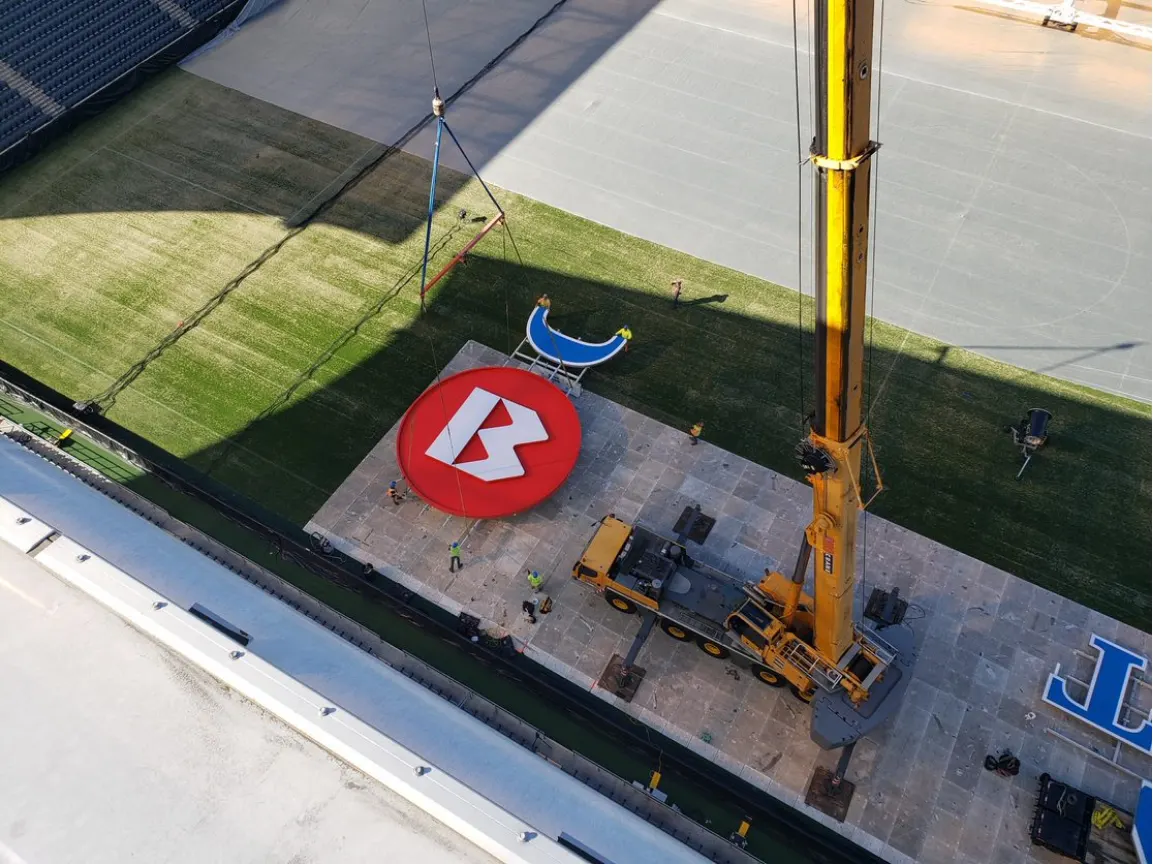
The math on a complex build is simple: More sites = more risk – unless someone is holding it all together.
Think about a national retailer rolling out a brand refresh across fifty locations. Or a hospital system building three new facilities on overlapping timelines, each with its own permitting and inspection cycle. Or a stadium program moving through phased construction while games are still being played inside.
None of these are single projects with straightforward timelines. They're networks of moving parts that must hit precise deadlines, meet high standards, and stay within an overarching budget. Typically, business operations must continue during installation, so crew, customer, and fan safety is also a top concern.
That's where enterprise project management services become critical. They include coordinating, scheduling, budgeting, permitting, and multi-trade execution. And when a program includes custom signage, interior branding, and architectural elements, sign installation services are also part of that same coordinated framework.
What does that coordination actually look like on the ground? Why does it matter? And what should you look for in a signage partner? Let’s talk about it.
What Enterprise Project Management Services Include on Complex Builds
Flawlessly managing one construction site is a skill. Managing fifty of them, on the same timeline, under the same brand standard, is a different discipline entirely.
Enterprise project management services treat multiple interconnected projects, sites, or phases as one coordinated program, not a stack of isolated jobs that happen to share a client name.
A national retail rollout, a multi-building corporate campus, or a phased stadium expansion can't run on separate spreadsheets and assumptions at every location. Someone has to see the whole picture, and that's where enterprise-level coordination comes in.
In practice, that coordination breaks down into a handful of operational components:
- Ability to rapidly scale manpower as required.
- Budget tracking, permitting, and code compliance management that keep every site accountable to the same financial and regulatory standards.
- Multi-site scheduling and phased sequencing that keep every region moving on a single coordinated timeline.
- Quality control, safety oversight, inspection, and completion reporting that confirm every location meets the same standard before sign-off.
- Sign installation services that get coordinated across dozens or even hundreds of locations without losing consistency from one site to the next.
- Site logistics and field-crew deployment that get managed across multiple markets at the same time.
- Vendor, subcontractor, and trade-partner oversight that keeps every party working from the same plan instead of their own version.
How Coordinated Project Management Reduces Risk on Complex, Multi-Site Builds
Centralized coordination helps catch permitting delays, site-readiness issues, inconsistent sign specifications, or installation conflicts before they affect the wider rollout.
When scheduling, budgeting, and quality standards run through one coordinated framework instead of a dozen disconnected ones, timelines become predictable instead of aspirational. Construction and brand standards stay consistent – whether you're looking at location one or location fifty.
And if something does go wrong, there's one point of accountability instead of a circle of vendors each pointing at someone else. That's the actual value that construction management services and project management services deliver on a program this size. You need a partner that can absorb problems without falling apart.
Why Jones Is the Right Partner for Enterprise Project Management
Choosing a sign installation company for a program like this comes down to a short list of practical questions.
- Can they actually handle multiple sites at once, not just one well-run job?
- Do they build things themselves, or hand off parts to subcontractors they don't fully control?
- When a decision is needed, is one team responsible, or do we have to loop in a chain of vendors?
Here's how we answer those questions:
- We have proven experience managing multi-site, multi-phase commercial programs.
- We offer in-house fabrication with our nationwide sign installation services, and also manage design, fabrication, permitting, and installation.
- We keep a single point of accountability from design through close-out.
We’re built to handle complex design-build project management, which makes all the difference between hiring a turnkey construction services partner and assembling a patchwork of vendors who each own just a small piece of the outcome.
Manage Complex Builds With Jones
Enterprise project management services and sign installation services aren't two separate disciplines that happen to overlap on big projects. Run correctly, they're one system that keeps large, multi-site programs on schedule, on budget, and consistent from the first location to the last.
If you're an architect, developer, or brand and facility manager staring down a complex build, we'd like to be the team holding it together. Contact Jones to talk through project management support!